How the Myodural Bridge Connects Upper Cervical Health to Whole-Body Wellness
Quick-read highlights
- The myodural bridge (MDB) is a collagenous band that anchors deep sub-occipital muscles to the spinal dura at C0-C2. (pubmed.ncbi.nlm.nih.gov)
- Every head nod and micro-contraction of those muscles transmits a pump-like force to cerebrospinal fluid (CSF), modulating pressure and venous outflow. (frontiersin.org)
- Atlas or axis misalignment can disturb muscle tone, stretch the MDB, and alter CSF dynamics—producing headaches, dizziness, brain-fog, and more. (nature.com)
- Upper Cervical Chiropractic (UCC) adjustments aim to restore neutral mechanics at C1-C2, normalizing MDB tension and CSF flow. Early studies and clinical reports show promising symptom relief. (chiropracticscience.com, craniocervicalfoundation.org)
1. Anatomy 101: meet the myodural bridge (MDB)
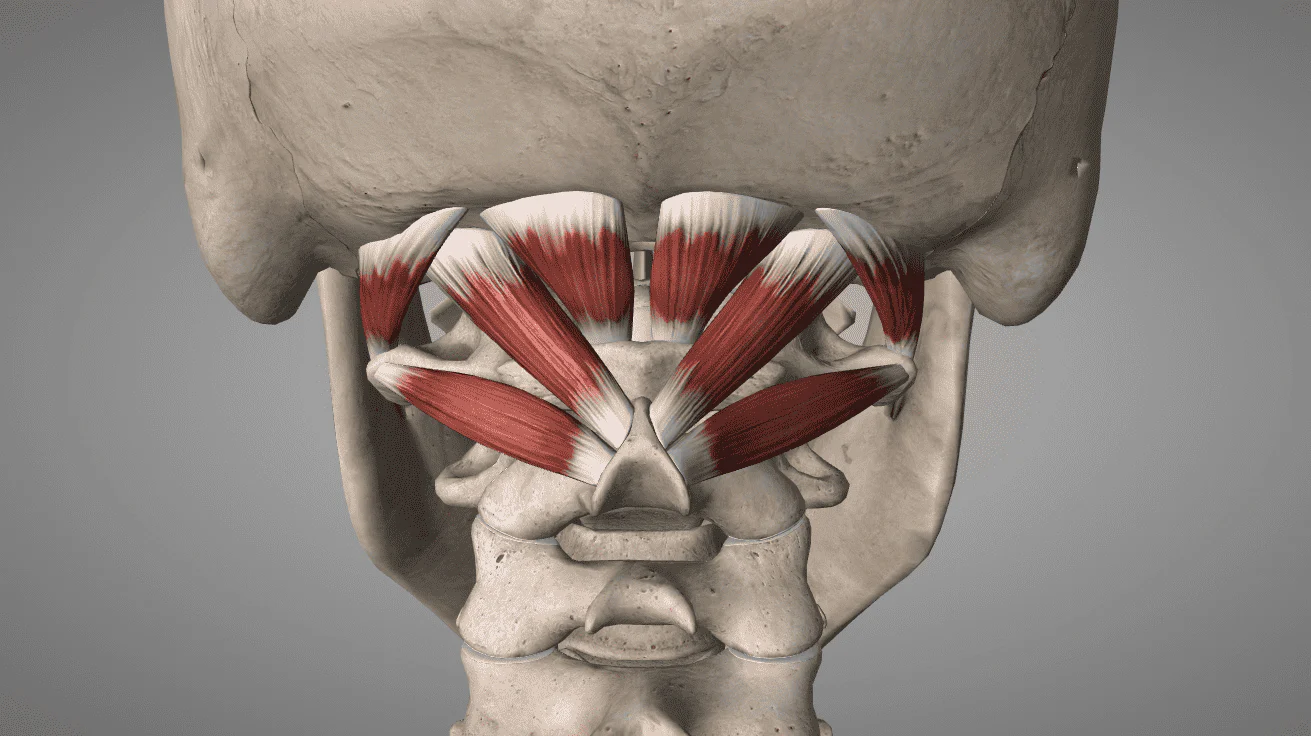
Three small “posture-control” muscles—rectus capitis posterior minor (RCPm), rectus capitis posterior major (RCPM), and obliquus capitis inferior—share fibrous extensions that pierce the posterior atlanto-occipital membrane to blend with the spinal dura. Think of this as a living tether that keeps the cord from buckling when you look up, down, or side-to-side. (pmc.ncbi.nlm.nih.gov)
2. Why cerebrospinal fluid (CSF) flow matters
CSF bathes the brain and spinal cord, clearing metabolic waste and damping mechanical shocks. Unlike blood, CSF lacks a dedicated “heart.” Instead, it relies on respiration, arterial pulsation—and, according to recent MRI and animal studies, micro-pulses transmitted through the MDB. (frontiersin.org, pmc.ncbi.nlm.nih.gov)
When MDB tension is optimal, those pulses act like a gentle piston, helping CSF circulate through the foramen magnum and cervical canal. Too much or too little tension can stall the flow, leading to pressure changes implicated in Chiari I malformation, spontaneous intracranial hypotension, and chronic headaches. (nature.com, nature.com)
3. Upper Cervical misalignment: a hidden stressor
Even a 1-2 mm “kink” at the atlas or axis redistributes load to the sub-occipital muscles. They respond by tightening on one side and lengthening on the other—twisting the MDB like a rope and tugging on the dura. Patients often feel this as:
- Occipital or “band” headaches
- Neck stiffness or grinding
- Brain-fog when bending forward
- Vertigo triggered by quick rotation
These symptoms parallel findings in MDB fibrosis models that show reduced CSF velocity and dural irritation. (nature.com, cell.com)
4. Upper Cervical Chiropractic care: precision makes the difference
Unlike general spinal manipulation, UCC focuses exclusively on C1-C2 using pre-adjustment imaging (cone-beam CT, 3-view X-ray, or upright MRI). The goal is a vectored, low-force correction that:
- Centers the atlas beneath the skull, balancing sub-occipital muscle length.
- Unloads the MDB, letting it resume its spring-like role in CSF propulsion.
- Removes dural torque, decreasing nociceptive signaling that drives cervicogenic headache.
Case-series data and patient-reported outcomes show marked improvement in whiplash-related headaches, post-concussion symptoms, and even idiopathic intracranial hypertension after UCC programs. (chiropracticscience.com, craniocervicalfoundation.org)
Emerging evidence: A 2024 Frontiers in Neurology review emphasized MDB-mediated CSF regulation and called for controlled trials of targeted rehabilitation—an invitation tailor-made for Upper Cervical specialists. (frontiersin.org)
5. Key takeaways
- Tiny tether, huge impact—The MDB translates neck-muscle activity into healthy spinal-fluid motion.
- C1-C2 alignment matters—Misalignment distorts MDB tension, disturbing CSF flow and triggering pain.
- Upper Cervical care offers a mechanical fix—Precise corrections restore balance where medication can’t.
- Research momentum is strong—New imaging and surgical studies validate the MDB concept and highlight non-invasive options.
If you are a new patient and you have mysterious neurological symptoms getting your Upper Cervical Spine evaluated might reveal the culprit for your condition.
For existing patients by understanding the Myodural Bridge you can understand the value of staying properly aligned.
References
- Magnetic-resonance-based classification of the myodural bridge. 2023. (pubmed.ncbi.nlm.nih.gov)
- Neuraxial biomechanics, fluid dynamics, and myodural regulation. 2024. (frontiersin.org)
- Cervical myodural bridge: review of literature and clinical implications. 2014. (pmc.ncbi.nlm.nih.gov)
- New surgical approach for Chiari I preserving the MDB. 2025. (nature.com)
- Evidence for chronic headaches induced by MDB changes. 2023. (nature.com)
- Full recovery from whiplash with Upper Cervical care. 2018. (craniocervicalfoundation.org)