Why you can be tired and sore at the same time — for no reason you can name
You slept eight hours. You didn’t lift anything heavy, didn’t run, didn’t do anything you’d describe as strenuous. By two in the afternoon your shoulders ache, your neck feels like it’s carrying something, and you’re as tired as if you’d been awake for two days.
If that sounds familiar, you’re in very good company. It’s one of the most common things I hear in this office — some version of I hit a wall in the middle of the day. People describe it almost identically: fine in the morning, wrecked by early afternoon, sore in places they never used. It comes up so often that I’ve stopped treating it as a side comment and started treating it as information.
Because it is. Nothing is wrong with you. You’re just paying for something you can’t see.
Here’s a way to think about it that most people never hear: your body runs on an energy budget, and inefficiency is a tax on it. Every day you have a certain amount to spend on work, family, exercise, and thinking clearly. Some bodies spend that budget well. Some bodies spend a surprising portion of it just holding themselves together — and the two symptoms that show up when they do are pain and fatigue, arriving together, seemingly out of nowhere.
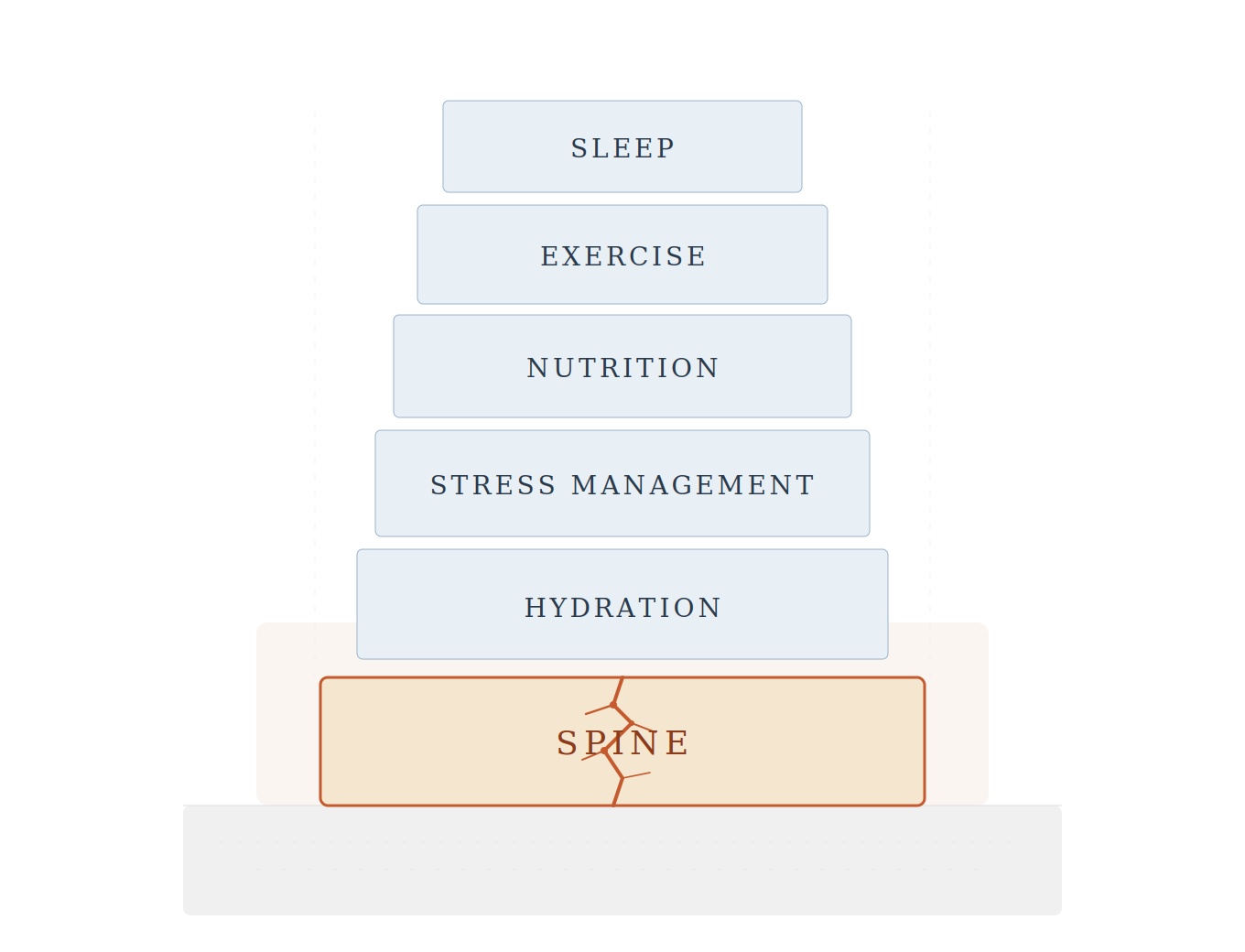
The spine sits at the center of two specific inefficiencies. One is mechanical. One is neurological. And the reason they matter so much is that they feed each other.
Inefficiency #1: Your body pays more for the same movement
Your spine is built to distribute load. The curves in your neck, mid-back, and low back aren’t decorative — they’re a suspension system, spreading force across many segments so that no single structure carries much. When that system works, staying upright is nearly free. Your deep postural muscles are built for exactly this: low-effort, all-day endurance work.
When the system stops sharing load evenly, the work doesn’t disappear. It gets redistributed — usually to tissue that wasn’t designed for it. Endurance muscles get drafted into jobs meant for prime movers. Prime movers stay switched on when they should be resting.
You can feel this in about sixty seconds.
Try it now. Sit up in your chair. Let your head drift forward two inches — the position you’d take to read something slightly too small on a screen. Hold it. Count to sixty.
Somewhere around thirty seconds you’ll feel a burn at the base of your skull and across the tops of your shoulders. Nothing is moving. You’re not lifting anything. You are, in the most literal sense, burning energy standing still.
Now consider that many people hold some version of that position for six to eight hours a day.
This is what mechanical inefficiency means. It isn’t drama or damage. It’s a slow leak — a small tax, charged constantly, on a budget you were counting on for other things. The soreness at 2pm isn’t an injury. It’s the invoice.
But there’s a second cost, and it’s the one I’d actually rather you took seriously.
A fatigued muscle isn’t just a tired muscle. It’s a muscle that has lost some of its ability to protect you. Tired muscle responds a beat slower, absorbs force less well, and gives out earlier than it should — which means the joint underneath it takes more of whatever happens next. That’s the whole reason injuries so rarely occur during the thing you’d expect. Almost nobody strains their back on the first box. They strain it on the eleventh, or reaching for a bag of groceries at 6pm after eight hours of quietly overpaying for posture.
So the muscles running inefficiently all day aren’t only draining you. They’re also the ones least prepared for the moment you finally need them — and they tend to be asked for something right around the time they have the least left to give.
Inefficiency #2: Your body pays more for the same information
The second inefficiency is less familiar, and it’s the more interesting one.
Your spine isn’t only a structural column. It’s also one of the richest sources of positional information in your entire body. The joints and deep muscles along it are packed with sensors that continuously report where you are in space — how you’re tilted, how you’re loaded, what’s about to happen. Your brain uses that stream to build a working map of your body.
When spinal segments move poorly, the stream gets noisy. The map loses resolution.
A brain working from a low-resolution map doesn’t shut down. It does something more expensive: it hedges. It raises baseline muscle tone. It co-contracts muscles that should be taking turns. It guards. It moves you more slowly and more cautiously than the situation actually requires.
Think about driving in heavy fog. You don’t stop. You slow down, lean forward, grip the wheel, and stare hard at the road. You cover thirty miles and arrive wrung out — not because thirty miles is far, but because you spent every one of them braced against what you couldn’t see clearly.
Guarding is your body driving in fog. And guarding is metabolically expensive. It’s also, over time, uncomfortable in its own right — sustained muscle tension hurts, regardless of what caused it.
The part that matters: these two form a loop
If mechanical and neurological inefficiency were separate problems, you’d address them separately and be done.
They aren’t separate. They’re a circuit.
Poor mechanics degrade the quality of the signal your spine sends. A degraded signal makes your nervous system protect. Protection means stiffness, guarding, and elevated tone. Stiffness and guarding further restrict how well those segments move — which degrades the signal again.
Around it goes, quietly, for years. This is why the problem so often feels like it has no cause. There isn’t a moment of injury to point at. There’s a loop that’s been running slightly hot for a long time, and one day you notice you’re tired in a way sleep doesn’t fix.
It’s also why the spine is worth attention out of proportion to its share of your anatomy. It isn’t just another body part to maintain. It’s the junction where these two inefficiencies meet and reinforce each other — which makes it a leverage point. Improve how those segments move and load, and you’re not treating one symptom. You’re interrupting the circuit at the place where both halves connect.
What “better” actually feels like
Clinical language is bad at describing this. “Improved range of motion” and “reduced pain scores” are true and completely fail to capture what people actually notice.
What they notice is this:
- You stop bracing — and only realize afterward that you’d been braced for months.
- Turning your head to reverse the car stops being a small decision and goes back to being nothing.
- You get to the end of a workday with something still in the tank.
- The 2pm shoulder ache doesn’t get treated. It just stops showing up.
That last one is the tell. When an inefficiency is corrected rather than managed, the symptom doesn’t get quieter — it stops being generated. There’s nothing left to feel because there’s nothing left being paid for.
And the wall is the clearest place to watch it happen.
I’ve now seen this pattern enough times to describe it before patients do. The wall doesn’t break — it moves. Someone who used to fall apart at one o’clock starts making it to three. Then to five. Then they mention, almost in passing and usually weeks late, that they can’t remember the last time it happened at all.
I point this out because it’s the most useful thing you can track yourself, and almost nobody thinks to. You don’t need to score your pain out of ten. Just notice what time it shows up. If that hour is drifting later, the inefficiency is coming down — you’re spending less to get through the same day, so it takes longer to run out. That’s the budget rebalancing in real time, and it’s visible weeks before anyone would think to call themselves better.
The short version
Pain and fatigue that arrive together, with no obvious cause, are worth taking seriously — not because something is broken, but because something is costing more than it should. A body that’s inefficient mechanically burns energy holding itself up. A body that’s inefficient neurologically burns energy bracing against a blurry map. A spine that moves poorly does both, and each one makes the other worse.
You have a budget. It’s worth knowing what’s drawing on it.